California

California Lien Waiver Forms

California prints all four lien waiver forms in the Civil Code. A waiver that is not substantially in the statutory form is null, void, and unenforceable.

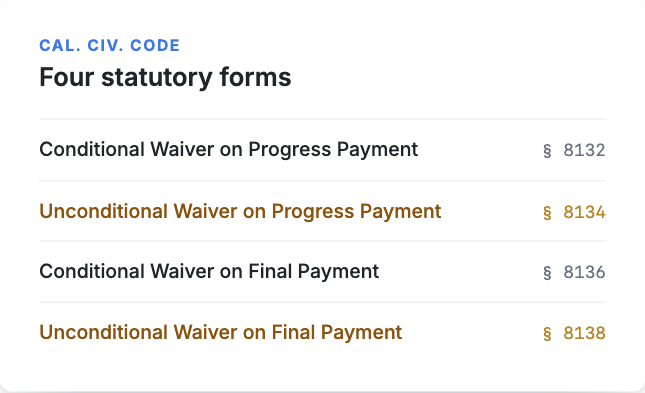
The four California statutory lien waiver forms, conditional and unconditional, for progress and final payment
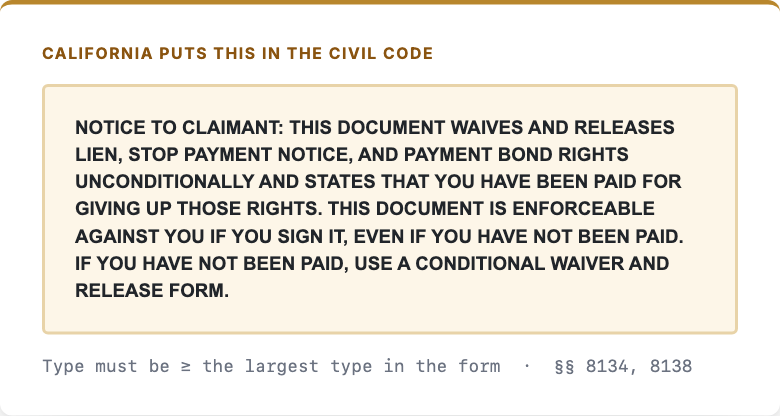
Notice to Claimant required on a California unconditional waiver
The four statutory forms in the California Civil Code
Download all four forms ZIP, four print-ready one-page PDFs. No email required.
Statutory text verified Sep 7, 2026 Forms in force since Jul 1, 2012 Free, no sign-up

A waiver and release does not release the owner, the construction lender, or a payment bond surety unless it is substantially in the statutory form and signed by the claimant, and, for a conditional release, there is evidence of payment.

Cal. Civ. Code § 8124

California is stricter than most states about what counts as evidence of payment. Under § 8124(b) it is either the claimant's endorsement on a check the bank has actually paid, or a written acknowledgment of payment. A copy of the check on its own is not it.

The four forms below are the Civil Code text, laid out the way the CSLB publishes them. Fill in the fields. Do not reword the release paragraph or drop the Exceptions block.

Filling them in is the tedious part, and it is the part APARBooks does for you. See how the blanks fill themselves from the payment you already recorded.

California

Two questions get you to the right form

Has the money actually cleared? And is this a progress payment or the last one? That's the whole decision.

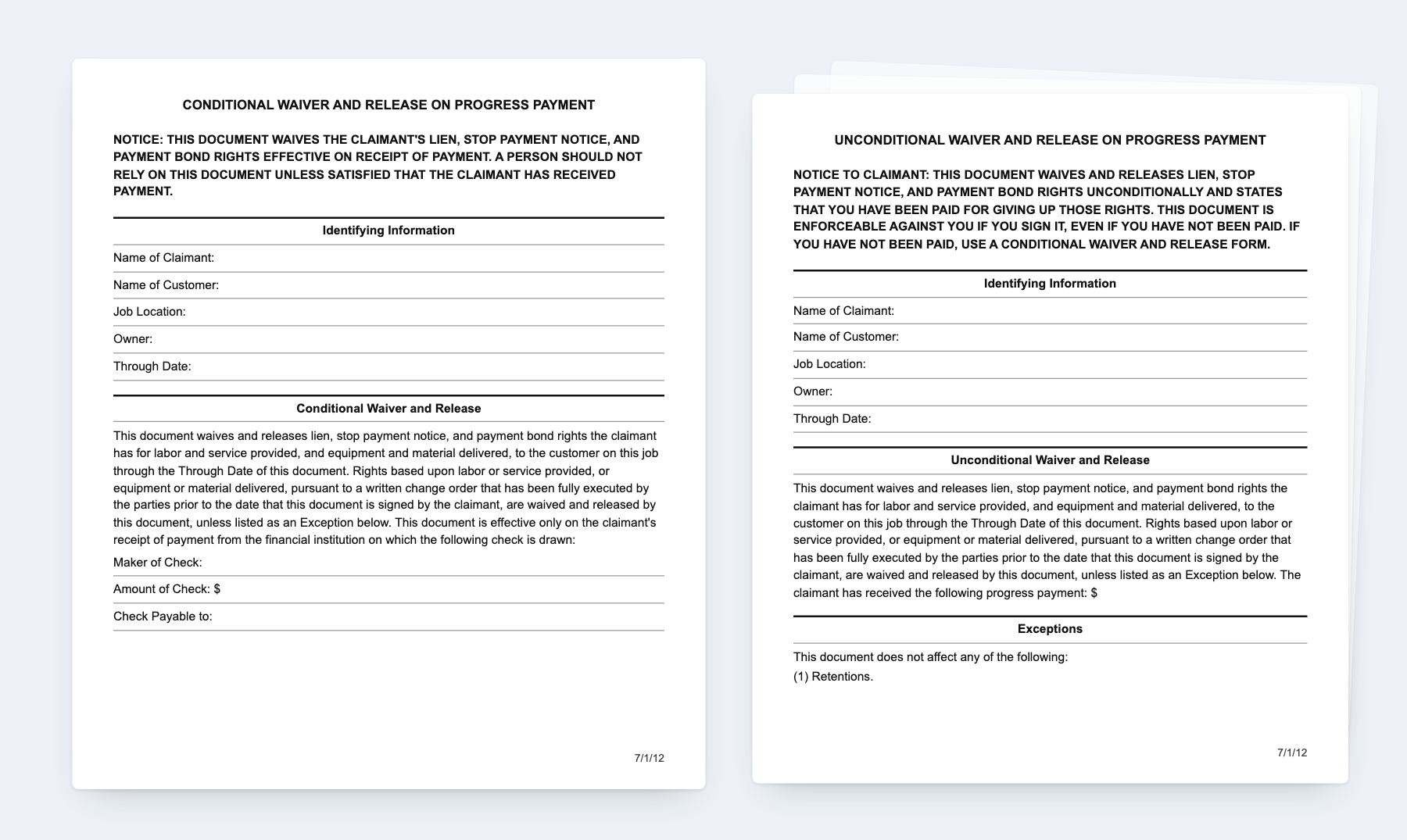
Conditional Waiver and Release on Progress Payment

Cal. Civ. Code § 8132
Download PDF
Use it when: you're asked to sign in exchange for a progress payment and you have not been paid yet, or you were handed a single-payee or joint-payee check.
CONDITIONAL WAIVER AND RELEASE ON PROGRESS PAYMENT
NOTICE: THIS DOCUMENT WAIVES THE CLAIMANT'S LIEN, STOP PAYMENT NOTICE, AND PAYMENT BOND RIGHTS EFFECTIVE ON RECEIPT OF PAYMENT. A PERSON SHOULD NOT RELY ON THIS DOCUMENT UNLESS SATISFIED THAT THE CLAIMANT HAS RECEIVED PAYMENT.
Identifying Information
Name of Claimant:
Name of Customer:
Job Location:
Owner:
Through Date:
Conditional Waiver and Release

This document waives and releases lien, stop payment notice, and payment bond rights the claimant has for labor and service provided, and equipment and material delivered, to the customer on this job through the Through Date of this document. Rights based upon labor or service provided, or equipment or material delivered, pursuant to a written change order that has been fully executed by the parties prior to the date that this document is signed by the claimant, are waived and released by this document, unless listed as an Exception below. This document is effective only on the claimant's receipt of payment from the financial institution on which the following check is drawn:

Maker of Check:
Amount of Check: $
Check Payable to:
Exceptions

This document does not affect any of the following:

(1) Retentions.

(2) Extras for which the claimant has not received payment.

(3) The following progress payments for which the claimant has previously given a conditional waiver and release but has not received payment:

Date(s) of waiver and release: ____________________________

Amount(s) of unpaid progress payment(s): $ ____________________________

(4) Contract rights, including (A) a right based on rescission, abandonment, or breach of contract, and (B) the right to recover compensation for work not compensated by the payment.
Signature
Claimant's Signature:
Claimant's Title:
Date of Signature:
7/1/12
Scroll inside the form to read it all, or download the PDF above.

Unconditional Waiver and Release on Progress Payment

Cal. Civ. Code § 8134
Download PDF
Use it when: the progress payment is already in your account. Note the statute's own warning: this one binds you even if you were never paid.
UNCONDITIONAL WAIVER AND RELEASE ON PROGRESS PAYMENT
NOTICE TO CLAIMANT: THIS DOCUMENT WAIVES AND RELEASES LIEN, STOP PAYMENT NOTICE, AND PAYMENT BOND RIGHTS UNCONDITIONALLY AND STATES THAT YOU HAVE BEEN PAID FOR GIVING UP THOSE RIGHTS. THIS DOCUMENT IS ENFORCEABLE AGAINST YOU IF YOU SIGN IT, EVEN IF YOU HAVE NOT BEEN PAID. IF YOU HAVE NOT BEEN PAID, USE A CONDITIONAL WAIVER AND RELEASE FORM.
Identifying Information
Name of Claimant:
Name of Customer:
Job Location:
Owner:
Through Date:
Unconditional Waiver and Release

This document waives and releases lien, stop payment notice, and payment bond rights the claimant has for labor and service provided, and equipment and material delivered, to the customer on this job through the Through Date of this document. Rights based upon labor or service provided, or equipment or material delivered, pursuant to a written change order that has been fully executed by the parties prior to the date that this document is signed by the claimant, are waived and released by this document, unless listed as an Exception below. The claimant has received the following progress payment: $

Exceptions

This document does not affect any of the following:

(1) Retentions.

(2) Extras for which the claimant has not received payment.

(3) Contract rights, including (A) a right based on rescission, abandonment, or breach of contract, and (B) the right to recover compensation for work not compensated by the payment.
Signature
Claimant's Signature:
Claimant's Title:
Date of Signature:
7/1/12
Scroll inside the form to read it all, or download the PDF above.

Conditional Waiver and Release on Final Payment

Cal. Civ. Code § 8136
Download PDF
Use it when: you have the final check but it hasn't cleared. Unlike the progress version, there is no Through Date, so it reaches the entire job.
CONDITIONAL WAIVER AND RELEASE ON FINAL PAYMENT
NOTICE: THIS DOCUMENT WAIVES THE CLAIMANT'S LIEN, STOP PAYMENT NOTICE, AND PAYMENT BOND RIGHTS EFFECTIVE ON RECEIPT OF PAYMENT. A PERSON SHOULD NOT RELY ON THIS DOCUMENT UNLESS SATISFIED THAT THE CLAIMANT HAS RECEIVED PAYMENT.
Identifying Information
Name of Claimant:
Name of Customer:
Job Location:
Owner:
Conditional Waiver and Release

This document waives and releases lien, stop payment notice, and payment bond rights the claimant has for labor and service provided, and equipment and material delivered, to the customer on this job. Rights based upon labor or service provided, or equipment or material delivered, pursuant to a written change order that has been fully executed by the parties prior to the date that this document is signed by the claimant, are waived and released by this document, unless listed as an Exception below. This document is effective only on the claimant's receipt of payment from the financial institution on which the following check is drawn:

Maker of Check:
Amount of Check: $
Check Payable to:
Exceptions

This document does not affect any of the following:

Disputed claims for extras in the amount of: $

Signature
Claimant's Signature:
Claimant's Title:
Date of Signature:
7/1/12
Scroll inside the form to read it all, or download the PDF above.

Unconditional Waiver and Release on Final Payment

Cal. Civ. Code § 8138
Download PDF
Use it when: final payment has cleared. This is the strongest of the four and it has no Exceptions list for retention.
UNCONDITIONAL WAIVER AND RELEASE ON FINAL PAYMENT
NOTICE TO CLAIMANT: THIS DOCUMENT WAIVES AND RELEASES LIEN, STOP PAYMENT NOTICE, AND PAYMENT BOND RIGHTS UNCONDITIONALLY AND STATES THAT YOU HAVE BEEN PAID FOR GIVING UP THOSE RIGHTS. THIS DOCUMENT IS ENFORCEABLE AGAINST YOU IF YOU SIGN IT, EVEN IF YOU HAVE NOT BEEN PAID. IF YOU HAVE NOT BEEN PAID, USE A CONDITIONAL WAIVER AND RELEASE FORM.
Identifying Information
Name of Claimant:
Name of Customer:
Job Location:
Owner:
Unconditional Waiver and Release

This document waives and releases lien, stop payment notice, and payment bond rights the claimant has for all labor and service provided, and equipment and material delivered, to the customer on this job. Rights based upon labor or service provided, or equipment or material delivered, pursuant to a written change order that has been fully executed by the parties prior to the date that this document is signed by the claimant, are waived and released by this document, unless listed as an Exception below. The claimant has been paid in full.

Exceptions

This document does not affect the following:

Disputed claims for extras in the amount of: $

Signature
Claimant's Signature:
Claimant's Title:
Date of Signature:
7/1/12
Scroll inside the form to read it all, or download the PDF above.
California

You already typed all of this once

Every blank on these four forms is data you entered when you set up the project, signed the subcontract, or cut the check. APARBooks fills them from those records instead of asking you again.

1

Record the payment

Pay a subcontractor bill, submit a pay application, or write the check. Nothing extra to enter.

2

APARBooks picks the form

Conditional while the check is still outstanding, unconditional once it clears. Progress or final off where you are in the billing cycle.

3

The blanks fill themselves

Claimant, customer, job location, owner, and the check details all come off the project, the subcontract, and the payment you just recorded.

4

Sign and file

E-signature in the portal, no print and scan. The signed waiver is stored on the project with the rest of the pay application package.

On the California form, that means:

Blank on the form
Filled from
Name of Claimant
The subcontractor or supplier you are paying
Name of Customer
Your company, from the subcontract
Job Location
The job address on the project record
Owner
The owner on that project
Through Date
The end of the billing period you are paying
Maker of Check
The account the check is drawn on
Amount of Check  /  Check Payable to
The payment you just recorded
Claimant's Signature  /  Title  /  Date
Signed with the built-in e-signature, dated on signing

See how the automation works

Four rules that decide whether a California waiver holds

The form is the easy part. These are the sections that void one.

§ 8122

You cannot sign away someone else's lien rights

An owner, direct contractor, or subcontractor may not waive, affect, or impair another claimant's rights by contract or otherwise, with or without notice. Any contract term that purports to do so is void and unenforceable until that claimant signs and delivers a waiver of their own. A GC's subcontract cannot bind the sub's suppliers.

Void and unenforceable
§ 8126

A side letter or an email does not waive a lien

An oral or written statement purporting to waive, release, impair, or adversely affect a lien or claim is void, and creates no estoppel, unless it is a waiver and release under this article or the claimant has actually been paid in full. Saying "we're square" in writing releases nothing.

§ 8124(b)

Evidence of payment is defined, and narrowly

A conditional release only works if there is evidence of payment, and the statute lists exactly two kinds: the claimant's endorsement on a single or joint payee check that the financial institution has paid, or a written acknowledgment of payment by the claimant. Filing the waiver with a copy of an uncashed check leaves you unreleased.

§§ 8134, 8138

The type size on an unconditional waiver is part of the law

Both unconditional forms are void unless the Notice to Claimant is set in at least as large a type as the largest type otherwise used in the form. Shrinking that warning to fit a letterhead is enough to make the waiver unenforceable, which cuts both ways depending on which side of it you are on.

Type size is a validity requirement

California lien waiver FAQ

Still stuck? Email us at support@aparbooks.com.

Only if you are going to exchange a waiver at all. :State does not make you swap waivers for payment. What it does is decide what a waiver has to look like once you do. Most GCs, owners, and construction lenders ask for them anyway, and the moment someone asks, this is the form that has to be used. Something typed up from scratch usually is not worth anything.

Before, using the conditional version. It only takes effect once the check clears, so nobody gives anything up early and you are still covered if the check bounces. The unconditional version is for after the money has actually landed in their account. If someone hands you an unconditional form along with the check, they have it backwards.

They can still put a lien on the job, and the waiver you got from your sub does not stop them. You can only sign away your own rights, not somebody else's. If your sub buys material on account from a supply house, that supply house has its own claim until it gets paid. That is why GCs collect waivers down the chain, not just from the people they write checks to.

Do not ask for one in that situation, and do not lean on it if you get one. An unconditional waiver says the money already arrived. If it has not, the sub has signed away rights for a payment they never received, and that is a fight you do not want on your job. Ask for the conditional version with the check, and the unconditional one after it clears.

Nothing was released. That is the whole point of the conditional version: it only takes effect when the bank actually pays the check. If the check bounces, the lien rights are still there. It is also why a photocopy of an uncashed check is not proof of payment. What counts is the cleared check or written confirmation from the claimant that the money arrived.

Generate them from the payment instead of typing them. Everything the form asks for, who is being paid, the job, the owner, the check and the amount, is already in your books the moment you cut the check. APARBooks builds the right waiver for each sub off that payment, sends it out for signature, and shows you which ones came back. An afternoon of copy and paste turns into part of running the draw.

Yes. The forms call for a signature, not for ink, and electronic signatures are accepted on them. Printing, signing, scanning, and emailing thirty of these is habit, not a requirement. APARBooks has e-signature built in, so a sub can sign from a phone and the signed copy files itself against the project. If an owner or lender insists on a wet signature, that is their own condition, not something the law asks for.

Fill in the blanks, that is fine. Do not rewrite the paragraphs. :State only accepts these forms, and one that somebody edited can end up worth nothing to whoever was counting on it. If you need to carve something out, use the exceptions the form already gives you rather than adding language of your own.

:State does not require it. A signature from the claimant, or from someone authorized to sign for them, is enough. Wyoming and Mississippi are the two states that make you notarize a lien waiver. Plenty of owners and lenders ask for notarization anyway, but that is a condition in their contract, not something the law is asking for.

On a progress payment, no. Retention is the first thing listed in the Exceptions block, along with unpaid extras and earlier draws you never got paid for. The final payment forms have no Exceptions block at all. Sign one of those while retention is still outstanding and you have given up the retention too, which is the most common way people lose money on these.

Almost. We compared the four PDFs the Contractors State License Board publishes against the Civil Code line by line, and they match except on the last one: the CSLB version of the unconditional final waiver opens its exceptions with does not affect any of the following, where the statute reads does not affect the following. The law is what controls, so that is the wording on the forms here.

Yes. The wording is :State law itself, and laws are not copyrighted, so anyone can print these, fill them in, and use them. No sign-up and no email address. If you would rather not fill them in by hand at all, APARBooks generates them from the payment you already recorded.

Official sources

The forms on this page are laid out to match the ones the Contractors State License Board publishes, and the wording is the Civil Code itself, verified against leginfo.legislature.ca.gov on September 7, 2026. One difference is worth knowing: the CSLB PDF for § 8138 opens its Exceptions with does not affect any of the following, while the statute reads does not affect the following. The statute controls, so that is what these forms use. APARBooks is construction accounting software, not a law firm, and nothing here is legal advice. Confirm against the current code before you rely on a form, and talk to a California construction attorney about anything contested.

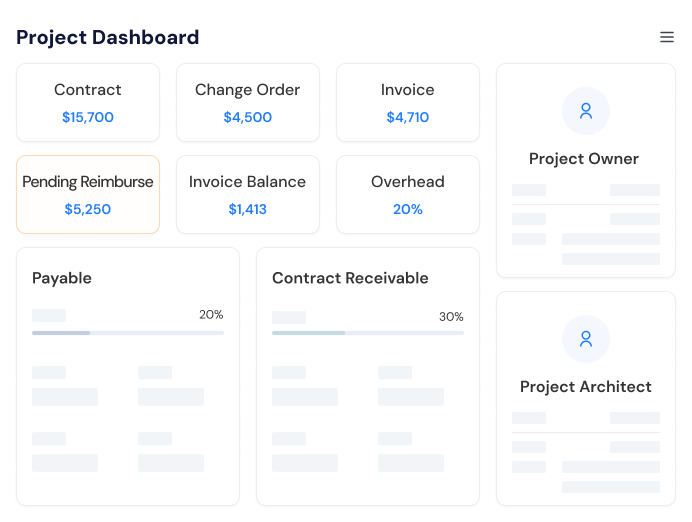
Project dashboard displaying contracts, invoices, reimbursements, and financial data for construction project tracking.
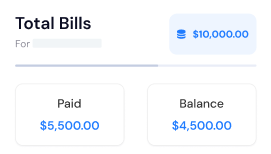
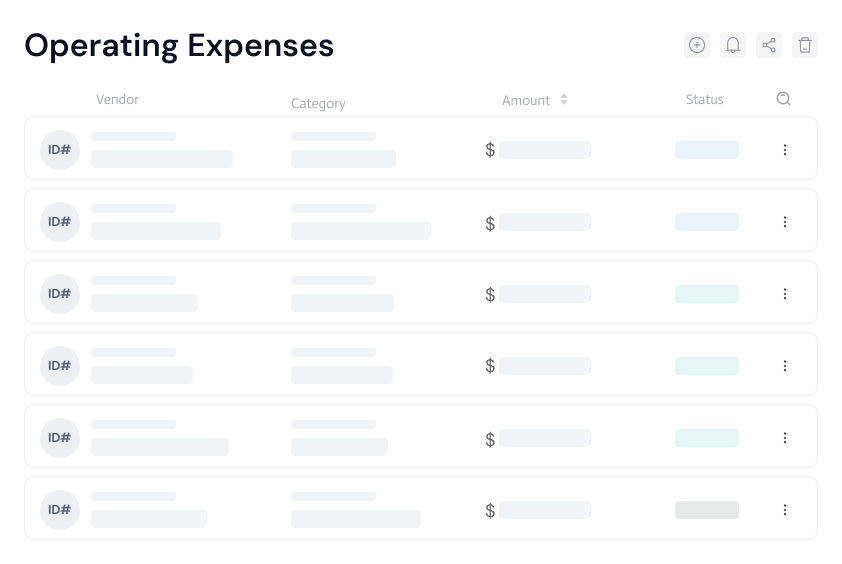
Total bills summary showing paid amounts, balances, and financial tracking for better cash flow management. Operating expenses list with vendors, categories, amounts, and payment statuses for expense tracking.

Ready to Replace Your Spreadsheets with Real Construction Accounting?

Join contractors who use APARBooks to manage job costs, AIA billing, subcontractor payments, and lien compliance all in one platform built for the way construction actually works. Request a free personalized demo today.

Request a Demo
Loading...