Retainage is the slice of every payment a client holds back, usually 5–10%, until the work is done and approved. It protects the owner and pushes contractors to finish. It also ties up a contractor's cash for the length of the job, and it has to be tracked as a receivable the whole time, not just billed at the end.
What retainage is
Retainage, also called retention or holdback, is a portion of a construction payment, typically 5–10%, withheld until a milestone or the completion of the whole project. It applies to both general contractors and subcontractors. For the client, usually the project owner, it is security: it holds back payment until the work meets the agreed standard and gives the owner recourse if it doesn't.
Why retainage matters
Retainage is a financial incentive to finish the work well. It matters most in the final stages: without it, a contractor who has already collected full progress payments might walk away if a dispute comes up. For owners, it is a cushion, funds available to pay subcontractors or bring in another contractor if the original one defaults.
The trade-off is cash flow. A contractor still has to cover wages, insurance, supplies, and new project costs while waiting on the final payment, and for a small business that strain can create tension in the relationship. Even so, retainage stays a standard tool for making sure projects get finished to standard.
How retainage works
Retainage is more involved than regular billing. You don't bill for it until the end, but it should be recognized as a separate receivable throughout the project.
Take a $10,000 line item with 10% retainage:
| Progress on the line item | Billed | Held in retainage |
|---|---|---|
| 10% complete | $900 | $100 |
| Each additional 10% | +$900 | +$100 |
| 100% complete | $9,000 total | $1,000 total |
The retainage becomes a true receivable as the project nears completion, and it is typically released on completion or after a set period, depending on the contract. On a project with 10 payments of $10,000 each at 10% retainage, the owner pays $9,000 each time and releases the remaining $10,000 at the end.
Small per-payment amounts add up over a job, which is the point: it is a strong incentive to finish. When the retainage terms are met, the retained amount goes to the contractor, who then pays the withheld money down to subcontractors. The exact percentage and terms vary by project stage, contract, and state.
The challenges of handling retainage
- Financial hardship. Subcontractors whose work finishes early wait the longest. Retainage is withheld until the entire project is done, and when it is paid it goes to the contractor first, then down to subs and suppliers.
- Delayed payment and abuse. Some contracts and state rules cap how long retainage can be held, but some parties hold to the last possible day. Disagreements over completion standards add delay. And contractors sometimes withhold a bigger percentage from subcontractors than the owner withholds from them.
- Administrative burden. Retainage adds bookkeeping and escrow-management work for everyone involved.
How APARBooks handles retainage bookkeeping
APARBooks can't fix the industry-wide payment problems, but it takes the bookkeeping off your plate. It is built for contractors and subcontractors, with data storage, a clear interface for tracking across projects, and automated calculations so the numbers are always right.
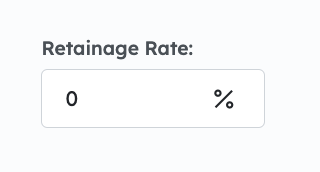
You set a preset retainage rate when creating an invoice for a project, and APARBooks includes it in every calculation from then on.
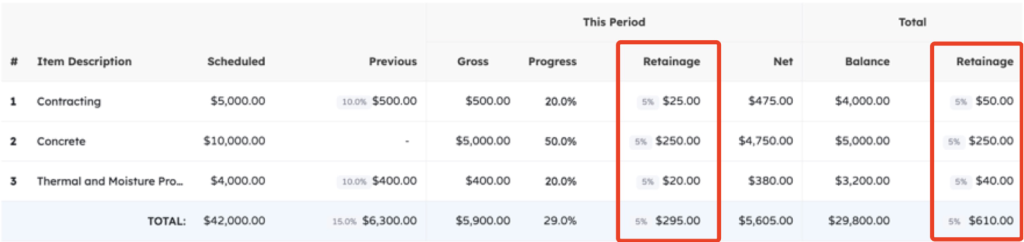
Every invoice shows precise retainage figures per cost item for the current period plus the overall totals, and highlights the gross, net, progress, and balance amounts, so you can track financial performance and retainage at a glance.
Frequently Asked Questions
What is retainage in construction?
Retainage, also called retention or holdback, is a portion of a construction payment, typically 5–10%, that the client withholds until a milestone or the completion of the project. It applies to general contractors and subcontractors and acts as security for the owner.
How is retainage calculated?
On a $10,000 line item with 10% retainage, billing 10% of the item bills $900 and holds $100. Each additional 10% holds another $100, so at 100% complete you have billed $9,000 and held $1,000.
When is retainage released?
Typically on completion of the project or after a specified period, depending on the contract terms. The contractor receives the retained amount and then pays the withheld portion down to subcontractors and suppliers.
Why does retainage cause cash flow problems for contractors?
The contractor keeps covering wages, insurance, supplies, and new project costs while 5–10% of every payment sits withheld until the end of the job. Subcontractors who finish early wait the longest for it.
Built for Contractors. Built for Construction Accounting.
APARBooks is purpose-built construction accounting software for general contractors and bookkeepers. Manage job costing, AIA progress billing, subcontractor payments, retainage, change orders, lien compliance, and WIP reporting in one place.