A general contractor's job runs on subcontractors, and messy accounting records are one of the fastest ways to strain those relationships. Between contract invoices, supplier invoices billed to a subcontract, and regular invoices, a GC can field dozens of bills a day, each needing to land against the right contract. This is where a clear subcontractor ledger earns its keep.
The problem: records that don't add up
Here is a common one. You pay for materials upfront and deduct that expense from the total committed contract value with your subcontractor. When the job finishes, the subcontractor has forgotten the deduction and demands the full remaining balance. The misunderstanding turns into a dispute and damages the working relationship.
Organizing invoices sounds like the fix, but the reality is harder. A general contractor often handles dozens of invoices a day, and keeping every one connected to the right project is a real problem at that volume.
Why multiple invoice types create confusion
Subcontractor invoices are not all the same. A general contractor is usually juggling three kinds at once.
| Invoice type | What it is | How it hits the books |
|---|---|---|
| Contract invoice | A bill against the subcontract itself. | Deducted directly from the contract. |
| Supplier invoice | Materials you purchase on behalf of the subcontractor. | Also deducted from the contract. |
| Regular invoice | Services or materials outside the contract. | Charged separately. |
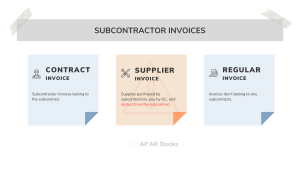
Now put multiple contracts under a single project. Contract invoices sometimes double as change orders, which affects both the contract balance and the total contract value. Suppliers add another layer by billing you directly for materials they provided to your subcontractors.
Supplier invoices are the hardest part
Subcontractors frequently get materials from suppliers and have the supplier send the invoice straight to the general contractor, to be deducted from the subcontractor's contract. Those supplier invoices fall into two categories: regular invoices, and invoices billed to a subcontractor contract.
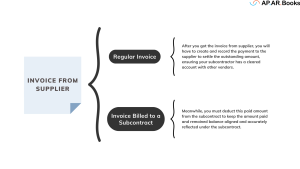
Checking these invoices becomes a headache when several subcontractors buy from the same supplier. You receive a pile of invoices, each of which has to be attributed to the correct subcontract and deducted properly. Without a structured system, the finances turn to chaos.
What a clear subcontractor ledger gives you
A clear ledger keeps the project inside its budget. You can monitor expenditures, make informed decisions about resource allocation, and avoid overspending. It also gives you a real-time view of cash flow, payments made and outstanding balances, so you know there is enough on hand to cover ongoing expenses and avoid a shortfall that halts progress.
A transparent system lets you hold subcontractors accountable: verify invoice accuracy, track payment schedules, and keep every transaction documented. It surfaces financial risk early, whether that is a billing discrepancy, a late payment, or an irregularity that would otherwise escalate. And timely payments plus transparent dealings build trust, which encourages subcontractors to prioritize your projects and offer better terms.
The cost of an inaccurate ledger
Failing to track subcontractor finances carefully has direct consequences. Unnoticed overspending strains the budget and cuts project profitability. Poor cash flow management delays payments, which halts work and disrupts the timeline. Inaccurate records lead to payment disputes, strained relationships, and legal issues.
How APARBooks organizes the subcontractor ledger
APARBooks is a construction accounting system built for this. It gives a general contractor a clear, organized view of financials and project detail across every subcontractor and contract.
Overview dashboard: the summarized ledger
Take the overview dashboard for a subcontractor, Jess Wood Work. It displays the key financial metrics, total committed amount, total paid, and balance, up front.
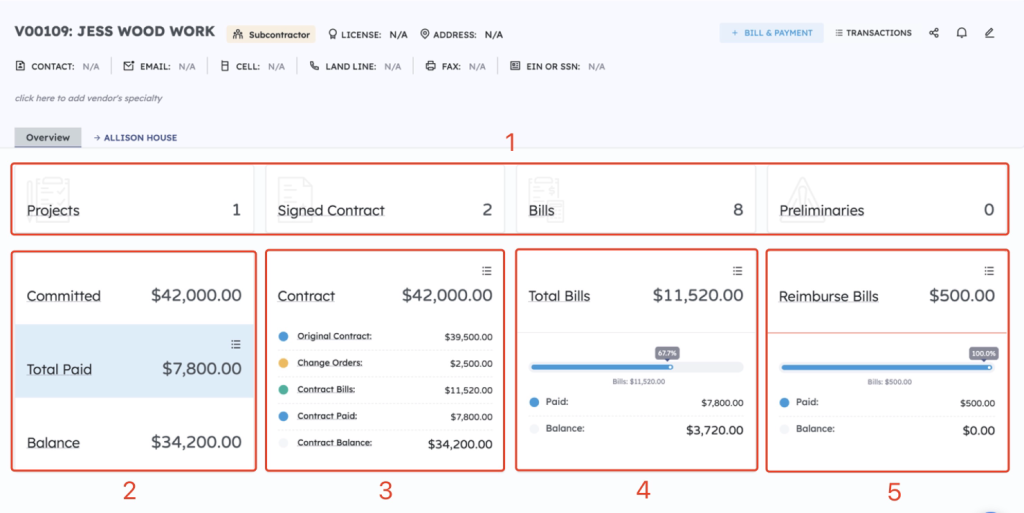
- The top of the dashboard shows how many projects, signed contracts, bills, and preliminaries this subcontractor holds with you.
- The total committed amount is $42,000, of which $7,800 has been paid, leaving a balance of $34,200 awaiting payment.
- Under the $42,000 contract, the finances break into categories so you can track how much has been paid, changed, and owed. This includes subcontractor bills, both regular invoices and supplier invoices.
- Total bills records every bill tied to the signed contracts with this subcontractor, with the amount paid, the balance awaiting payment, and a progress bar.
- Jess Wood Work paid $500 out of pocket and required a reimbursement. The amount paid, the balance, and the progress bar show that the reimbursement bills are paid off.
Detailed project insights
Staying with Jess Wood Work, you can drill into the Allison House project. APARBooks lets you export the project to a PDF or Excel file for sharing and calculation, and the PDF report shows every transaction under the project.
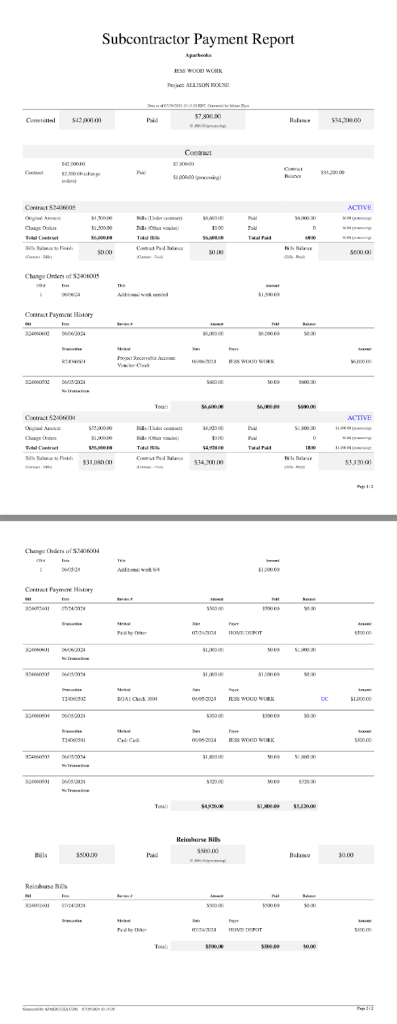
That level of detail lets you manage each vendor's contributions and financials, track which bills are pending, which are paid, and how much is left, which prevents discrepancies and keeps communication with vendors clean.
Why APARBooks
- At-a-glance view of financial commitments, payments made, and outstanding balances, so you can assess a project's financial health quickly.
- Detailed project dashboards showing contract amounts, change orders, bills issued, payments made, and remaining balances.
- Per-subcontractor tracking: financial transactions and project involvement recorded separately for each subcontractor.
- Early risk detection: spot discrepancies, monitor payment delays, and address issues before they escalate.
- Reports in the format you prefer, in a single click.
Frequently Asked Questions
What is the difference between a contract invoice, a supplier invoice, and a regular invoice?
A contract invoice is a bill against the subcontract and is deducted directly from the contract. A supplier invoice is for materials the GC buys on the subcontractor's behalf and is also deducted from the contract. A regular invoice is for services or materials outside the contract and is charged separately.
Why do supplier invoices cause the most trouble for general contractors?
Subcontractors often have suppliers bill the GC directly for deduction from the subcontract. When several subcontractors buy from the same supplier, the GC receives many invoices that each have to be attributed to the correct subcontract and deducted properly.
What happens if a subcontractor ledger is inaccurate?
Unnoticed overspending strains the budget and profitability, poor cash flow management delays payments and halts work, and inaccurate records lead to payment disputes and legal issues.
How does APARBooks track finances across multiple subcontractors?
APARBooks records financial transactions and project involvement for each subcontractor separately, with an overview dashboard showing total committed, total paid, and balance, and per-project detail down to individual bills and change orders.
Built for Contractors. Built for Construction Accounting.
APARBooks is purpose-built construction accounting software for general contractors and bookkeepers. Manage job costing, AIA progress billing, subcontractor payments, retainage, change orders, lien compliance, and WIP reporting in one place.